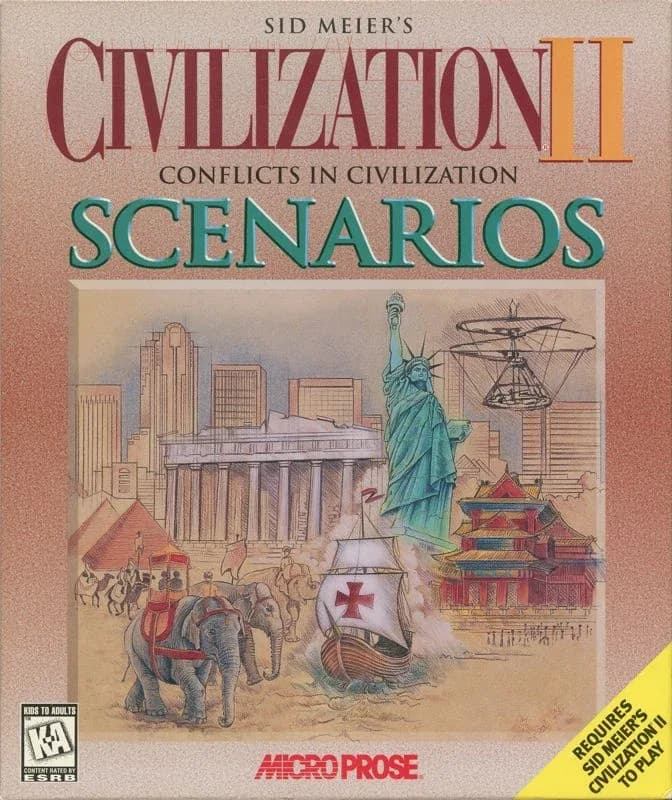
The first official expansion
Civilization II Scenarios: Conflicts in Civilization shipped on November 5, 1996 — nine months after Civilization II conquered the charts — and delivered twenty ready-to-play scenarios: twelve built by MicroProse's designers and eight community standouts curated from the early internet as the official "Best of the Net." Shipping fan-made work in a retail box was quietly radical in 1996, years before "modding scene" was an industry phrase.
The twelve in-house campaigns
- Antiquity to empire
- Alexander the Great (335–332 BC), Jihad: The Rise of Islam (624–750), The Crusades (1050–1250), The Mongol Horde (1206–1340).
- The age of powder and sail
- The Age of Discovery (1492–1741), The War of Independence (1775–1785), The Age of Napoleon (1798–1820).
- The modern cataclysms
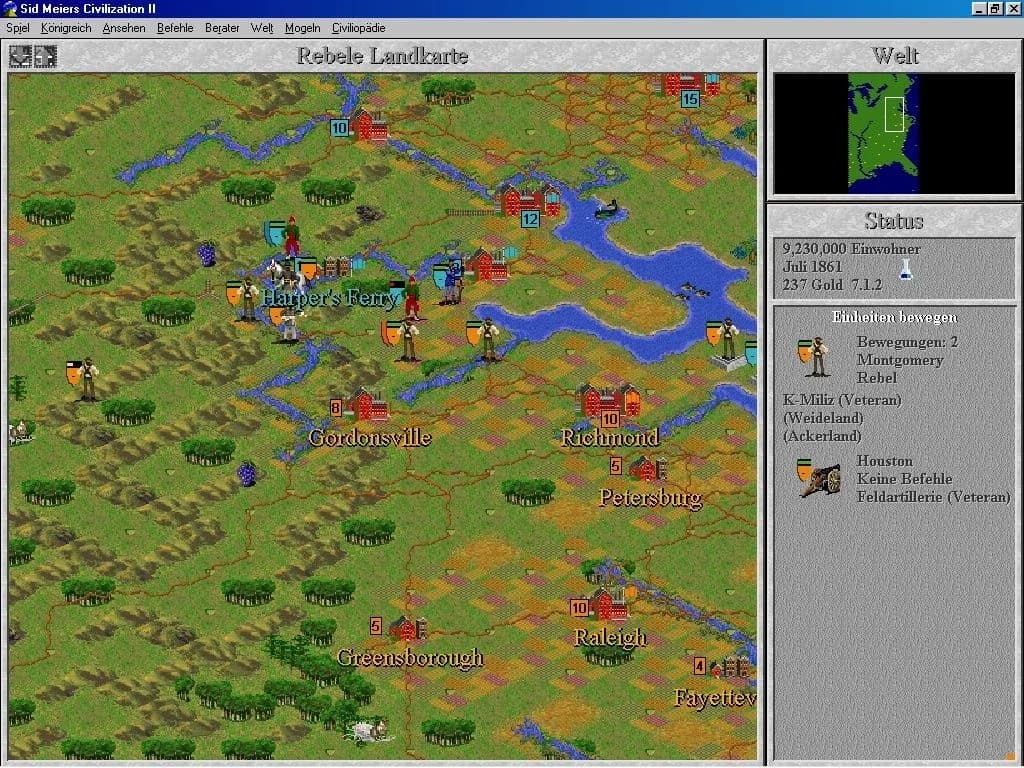
- The American Civil War (1861–1868) and The Great War (1914–1920).
- The speculative three
- World War: 1979 (the Cold War gone hot), Alien Invasion (here come the Hodads!) and After the Apocalypse (rebuilding 2010–2040).
The eight Best of the Net scenarios round the box out with player-built campaigns: Atolon, The Cholera of Zeus, The Conquest of Britain, Cross and Crescent, The Fall of the Great Kesh, East Wind, Rain, Persian Gulf War and Native Rebellion. A common mix-up worth avoiding: Rome and World War II are the two scenarios bundled with base Civ II — they are not in this pack.
The quiet revolution: a macro language
Conflicts in Civilization is remembered for its scenarios, but its most consequential cargo was technical: the disc introduced the Civ II events macro language — scriptable scenario events, no programming required — and updated the game to version 2.62. That language (often misattributed to the later Fantastic Worlds, which extended it) became the foundation of three decades of fan scenario-making. A free 1997 data update later rebalanced several campaigns, making the WWI and Civil War scenarios meaningfully harder.
Reception and afterlife
Reviews of the era were modest and mixed-to-positive — the German press settled around 75–80%, and more than one critic shrugged that it was "the same game with more scenarios." That was rather the point: Civ II had passed 600,000 copies sold by the month this pack shipped, and its players wanted exactly this. Both scenario packs were later folded into the Multiplayer Gold Edition (1998) and the 2006 Civilization Chronicles box, which is how most people play these campaigns today.
Playing Conflicts in Civilization today
Play Civilization II: Conflicts in Civilization in your browser — all twenty scenarios under emulation, with save states synced to your account. Brushing up before the Crusades? The Civ II encyclopedia covers every unit, the full tech tree and all 28 wonders.